‘A Brilliant Spectacle’
Ball at Government House 1898
600 invitations were sent out across New Zealand for a ball at Government House held on 27th October 1898. The governor and his wife, the Earl and Countess of Ranfurly, decided that it would be a fancy dress ball. Lord Ranfurly was the 11th Governor of New Zealand. He is remembered for his donation of the Ranfurly shield and the town of Ranfurly in Otago is named after him. In Wellington, the suburb of Northland was named after his son, then Viscount Northland.
The ball became the topic of conversation in Wellington. Costumes were ordered from England and Australia, Several Wellington women clubbed together and paid for a specialist hairdresser to come from Sydney for the occasion.
Lord Ranfurly and his family dressed as the family of their ancestor, Hon. Thomas Penn, the Governor and proprietor of Pennsylvania. Their costumes were copied from family portraits by Sir Joshua Reynolds.
The rooms at government house were decorated by Mrs Louisa Lockhart of the art florist company Gibbons & Co.. Trails of flowers formed garlands that fell from the arched divisions between the rooms. Great masses of lilies filled the fireplaces. There was no other colour, Lady Ranfurly believing that would come with the guests’ costumes. They had planned to take a photo of the decorated ballroom using a flashlight, but there was an accident on the test run a few nights earlier which caused the operator to burn his hands, and the ballroom floor was scorched.
At 9:30pm, the national anthem was played and the Vice-Regal party made their entry. They passed through the rooms and arranged themselves as a group at one end, to artistic effect. The first of the 22 dances began. It was a quadrille. Minifie’s band supplied the music.
Supper was served in the crimson dining room and a further 50 tables were provided in a marquee outside which was also lit with electricity. The tables were ‘laden with the daintiest and most delicious of dishes’.
‘To those who have never been out to the colonies it was a revelation, and to sit like little Jack Horner in one of the many cosy corners and gaze at the moving throng of grotesque or lovely figures that passed by was an enchanting occupation.’ (Evening Post, 28 October 1898)
‘Everyone was charmed with the success of the function, and though crooks, rapiers, ruffles and brocades are now put aside for walking sticks and umbrellas, tweeds and tailor-made gowns, we are all richer in the delightful memories of what is probably the most brilliant function of the kind ever held in New Zealand.’ (Press, 29 October 1898)
Among the other costumes was Cleopatra (Miss Donnelly), Marie Antoinette (Mrs Grace), Polish skater (Miss C. Smith), a wasp (Miss Barron), King & Queen of Clubs (Mr & Mrs A. Pearce), and Beatrice and Benedick (Mr and Mrs Castle Vaughan). In the days following the ball, many guests went to the Kinsey photography studio on Lambton Quay to have a photo taken in their costumes. These are available on DigitalNZ: https://digitalnz.org/records?text=government%20house%20ball%201898&i%5Bsubject%5D=Costume&page=1&tab=Images
The Vice Regal Party were photographed at Hermann studios the day after the ball. Lady Ranfurly did not attend. The governor’s staff were dressed as the staff of the Governor of Pennsylvania. The subjects of the photo and their costumes:
The Hon. Charles Hill Trevor (1863-1950)
Hill Trevor served as private secretary to Lord Ranfurly. Served in the First World War as a driver. Succeeded as 3rd Baron Trevor in 1923. In 1927 at the age of 63, he married Phyllis Sims.
His Excellency the Governor, Uchter John Mark Knox, 5th Earl of Ranfurly (1856-1933)
Lord Ranfurly succeeded in the earldom when his older brother died on a shooting expedition. He married Hon. Constance Caulfeild in 1880. He was governor of New Zealand between 1897 and 1904. In 1927, Lord Ranfurly sold the family seat, Northland House in Dungannon due to heavy post war taxation.
His costume as Hon. Thomas Penn consisted of pale blue and white brocade, with Limerick lace riffles, cut steel buttons and curled white powdered wig tied with a black ribbon.
Viscount Northland (1882-1915)
The only son of Lord and Lady Ranfurly. Lord Northland became Aide de Camp to his father from 1903 to 1904. Lord Northland was party to a public divorce in 1909 when John Stirling filed for divorce from his wife Clara Taylor, citing Lord Northland as co-respondent. Stirling won the case. Lord Northland married Hilda Copper in 1912. He was killed in 1915 in the First World War. His son became the 6th Earl of Ranfurly.
Lord Northland’s is dressed in costume as James, Earl of Charlemont. The outfit was entirely white, with no colour. The white brocade was patterned with a design of meadowsweet.
Captain Wellesley (1876-1941)
Arthur Wellesley was the eldest son of the 4th Duke of Wellington. He was commissioned as a lieutenant in the 4th battalion of the Lincolnshire Regiment in July 1897 and from 1898 was then Aide de Camp to Lord Ranfurly. In 1900 he joined the regular army as a second lieutenant of the Grenadier Guards and was part of a detachment sent to South Africa in March 1900. He served there until 1902. He married Lilian Coats in 1909 and succeeded to the Dukedom in 1934.
Captain Dudley Alexander (1863 -1931)
Son of a barrister, Captain Dudley was commissioned in the West Yorkshire Regiment in 1884. Captain Alexander was also a cousin of Lord Ranfurly and served as Aide de Camp for the full duration of the governor’s term. He remained with the family on their return to Ireland.
Lady Constance Knox (1885-1964)
The eldest surviving daughter of Lord and Lady Ranfurly. In 1904, at the last Court of the season, Lady Ranfurly presented Lady Constance to Queen Alexandra. This was the same Court at which Mrs George Donnelly (born Airini Karauria, a Ngāti Kahungunu woman of mana) was presented by Hon. Mrs Lyttelton. Mrs Donnelly also attended the 1898 costume ball at Government House. Lady Constance married Major Evelyn Gaskell in 1905.
Lady Constance and her sister were dressed as the daughter’s of Hon. Thomas Penn. Their dresses were made of white silk with tiny frills at the foot of the skirt. They wore turquoise sashes which fell to the foot of the skirt. Lady Constance also wore a frilled muslin cap.
Lady Eileen Knox (1891-1972)
Married Charles Clarke in 1914. Divorced in 1935 and married Peter Chappell in 1935.
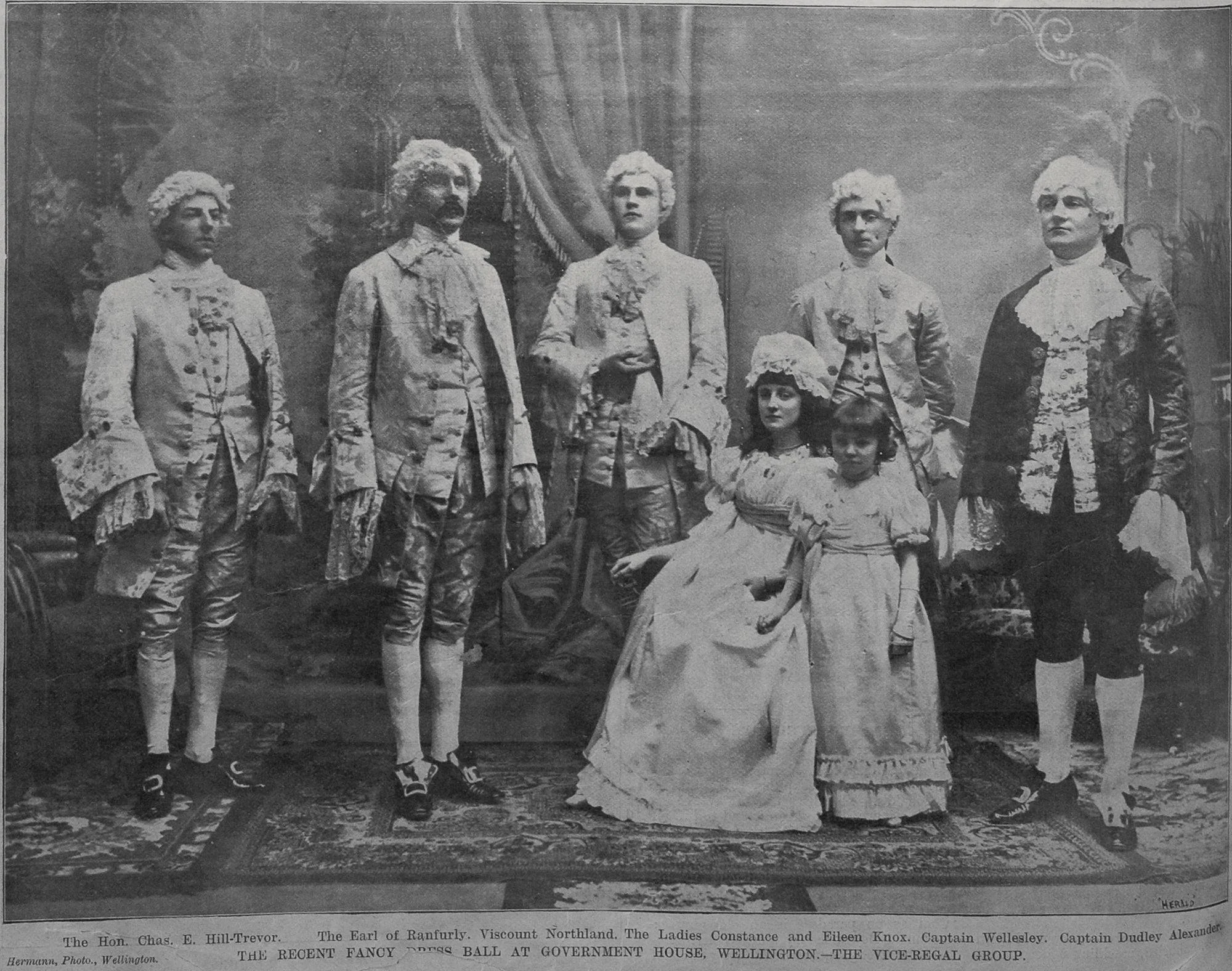
The recent fancy dress ball at Government House, Wellington- the vice regal group. Auckland Libraries Heritage Collections AWNS-18981118-04-02