German Internees
Somes Island 1914-1918
In August 1914, Somes Island in Wellington harbour was appointed as a place of interment for prisoners of war arrested in New Zealand. To maintain security, any vessel that went within half a mile of the island was at risk of being fired on. The first 90 prisoners were initially held at Alexandra Barracks and then marked down to the wharf to be taken by steamer to the island.
‘Among the German residents who were arrested this week in Wellington and taken away to Somes Island as prisoners of war was Mr Paul Dietrich, who some time ago started a business on Lambton-Quay as a ladies’ tailor. One could not but feel strong sympathy for the slight, blonde, rather fragile little man who had done no one any harm and has had a hard struggle to establish himself in business. He has fought bravely against adverse circumstances and just as his skill as tailor was coming to be recognised, war breaks out and down comes the hand of the Law, grips him by the arm and hales him away to Somes Island, all because Kaiser Bill can only see red and Paul Dietrich has had the misfortune to be born in Germany.’ (Free Lance, 15 August 1914)
By 1916, number of prisoners of war on Somes Island included 215 Germans, 20 Austrians, 1 Hungarian, 1 Turk, 2 Bulgarians, 1 American and 6 naturalised subjects of other countries. Of this number, 24 were military prisoners.
Prisoners could take up employment when it was available and were paid 3s per day. In 1916 some of the prisoners constructed additional accommodation for the prison guards. A small number worked in the cookhouse. Others used their time to make fancy boxes, walking-sticks, models of ships, cribbage boards, canvas shoes and fancy ornaments. Some prisoners keep chickens and others do gardening.
For exercise, the prisoners were are required to march around the island at certain times. They were allowed to swim in the sea in certain areas, whenever they liked between 6am and 6pm.
In August 1918, four German internees disappeared in the early hours one morning. A search was made but the authorities were satisfied that the men had not escaped in a boat. As the weather was also very tempestuous that night, they also presumed the men had not attempted to swim to the mainland. The four men reappeared within the wire three days later without explanation, rather hungry. They had hidden under the floor of their accommodation building. Their punishment was to be detained in the Terrace Gaol.
After the war ended, the internees were moved to Featherston Camp. In March 1919 the ship Willochra prepared to depart Wellington in order to repatriate over four hundred internees. A special train from Featherston with 242 internees aboard arrived at the wharf under the escort of returned soldiers. ‘Many of these internees appeared to be glad that they were leaving New Zealand.’
References:
Despatches from the Governor of New Zealand to the Secretary of State for the Colonies, 1917.
On Somes Island. (1914, August 13). Evening Post, 8.
Local Prisoners of War. (1914, August 11). Dominion, 6.
Repatriated. (1919, May 15). New Zealand Times, 7.
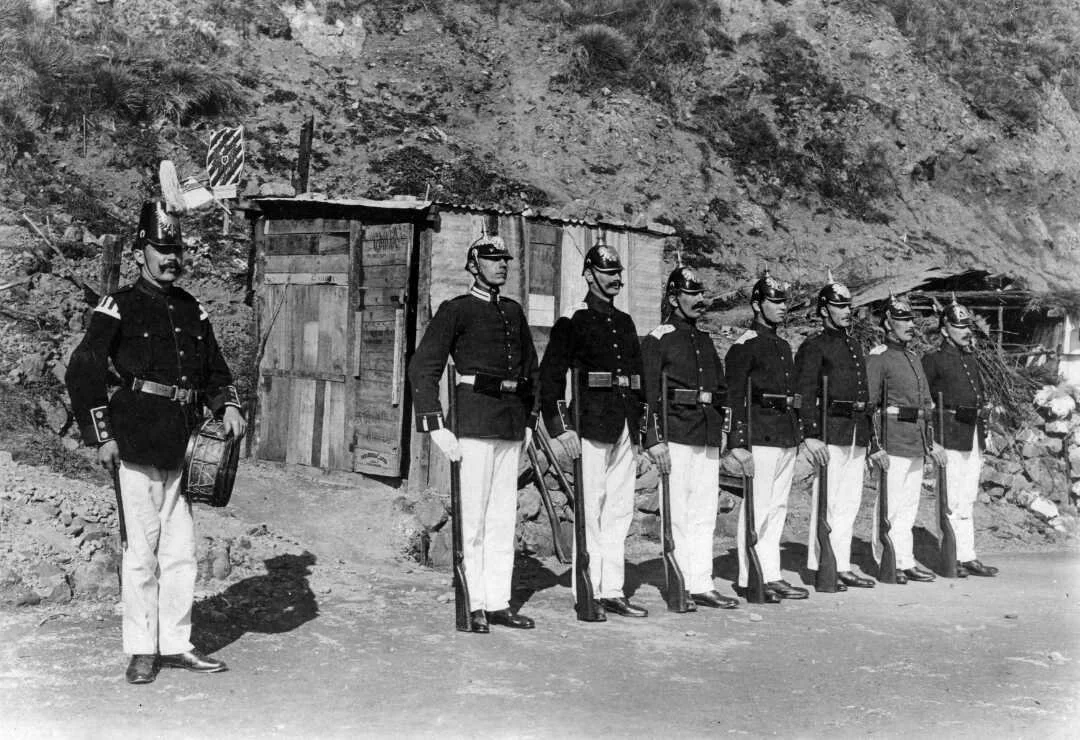
German internees on Somes Island. Hart, Roger :Photographs of Somes Island and other subjects. Ref: 1/2-112287-F. Alexander Turnbull Library, Wellington, New Zealand. /records/22340533
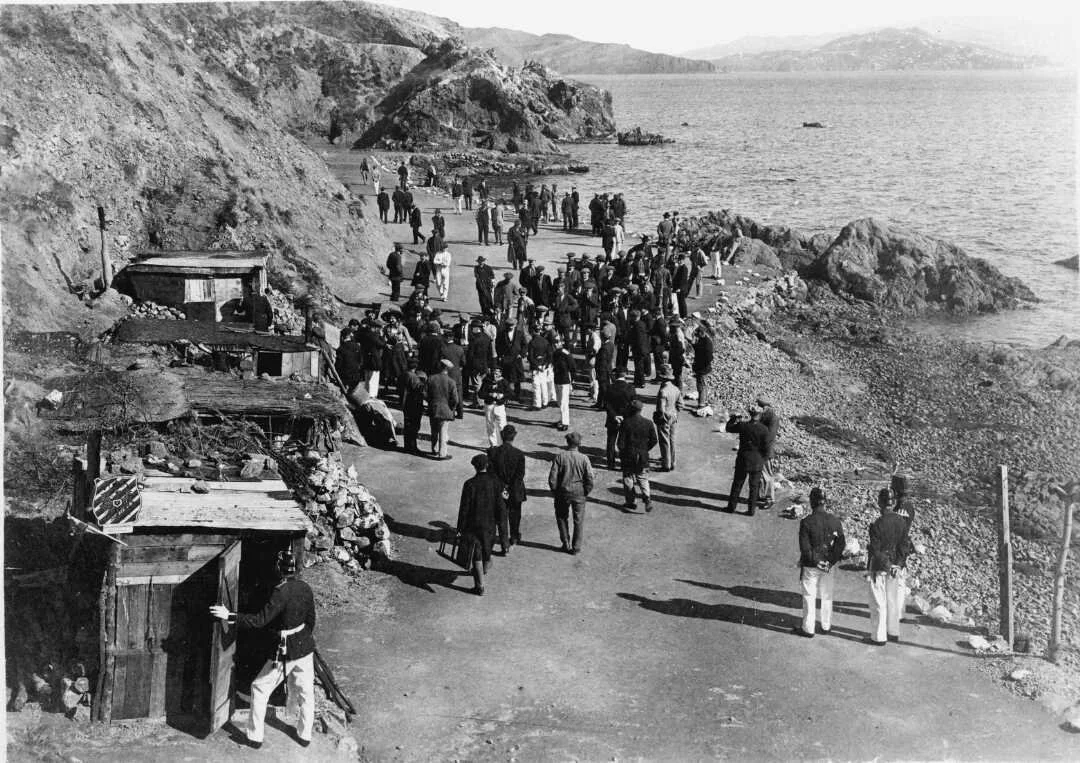
German internees on Somes Island. Hart, Roger :Photographs of Somes Island and other subjects. Ref: 1/2-112228-F. Alexander Turnbull Library, Wellington, New Zealand. /records/22401714
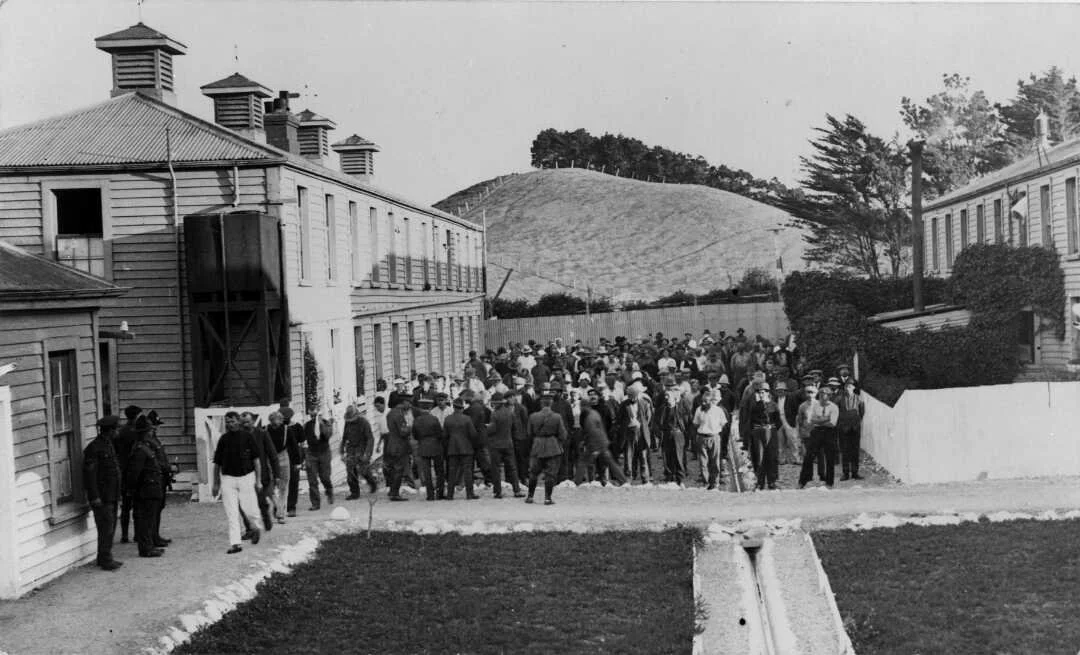
German prisoners of war on Somes Island. Ref: 1/2-112282-F. Alexander Turnbull Library, Wellington, New Zealand. /records/23095285