Jemima Oxenham
Married Four Times
Jemima Oxenham was the sixth woman to be married at Petone in the early days of the settlement. She emigrated with her brother John and older sister Sarah, on the ship Aurora, the first of the New Zealand Company ships to arrive at Port Nicholson. John was married but his wife and children remained behind in England. It appeared that his purpose in coming to New Zealand was to marry off his sisters. During the long voyage, Sarah and Jemima sewed their wedding dresses.
John was soon free of his responsibilities towards his sisters. Sarah Oxenham married George Batten on 21st April 1840. They were the fourth couple to be married at Petone. Jemima was not long behind. She married George Hamilton Coglan on 4th June 1840. The Aurora passenger list stated her age was 15 but she was born on 3rd October 1826, and so her age at the time of her marriage was 13 years and 8 months. Coglan was 28 years old. He was a merchant from Sydney and ran the Waterloo Stores at Britannia, the unsuccessful New Zealand Company settlement at Petone.[i]
By February 1841, Coglan had moved his business to the east end of Petone beach and was offering accommodation in his ‘Australian Tavern and Coffee Rooms.’[ii] According to family stories, ‘he was a brute and a drunkard and Jemima despised him.’[iii]
In August 1841, John dissolved his boat building business with Henry Meech, and returned to England. He never returned to New Zealand. His younger brother Nicholas Oxenham emigrated to Wellington later in the 1840’s.
Jemima’s marriage to Coglan did not last long. He drowned in an accident while crossing the harbour in a boat heavily laden with timber in December 1841.[iv] His body was never recovered. It was the responsibility of the Chief Constable of Wellington, Richard Burgess Sayer, to row across the harbour and tell Jemima that her husband had perished. According to family stories, on being told of the death of her husband she went upstairs to be alone. Sayer could hear strange noises and saw the chandelier swaying. On going to investigate he found Jemima dancing for joy. Sayer is said to have joined in the dance. Six months later they were married at the Wesleyan chapel in Wellington.
Sayers fortunes declined after being sacked from his job as Chief Constable in 1846.[v] He then became a butcher, a barman and finally a labourer. He died in the colonial hospital in 1854 suffering from delirium tremens, leaving Jemima with four children.
In 1855, aged only 28, Jemima married for a third time. Her husband was John Ashmore who was another early Wellington settler. They first resided in Molesworth Street and then moved to the Wairarapa by the late 1850’s where they lived on a few cleared acres. John died in Carterton in 1864 of natural causes. This marriage produced four more children.
One year after Ashmore’s death, Jemima married for a fourth time to Benjamin Stinson. Stinson was a few years younger than Jemima and a widower who came with a family of his own. Their little boy Arthur was born in 1867 and sadly Stinson died the same year. He was buried at Clareville cemetery.
Jemima survived him by barely two years. She died on 13th August 1869, aged 42 years. Her death was the subject of a series of hoax letters written by a ‘correspondent’ for the Wellington Independent, which printed:
‘On the night of her decease she called her little boy to her bed side, the only other living person near, to go for some neighbor, but he said “I cannot go, it is so very dark.” She then took him by the hand and squeezed it so that he could not release it from her affectionate, passionate, and dying grasp. In the morning she was found dead. The wretched whare in which she lived has since been levelled to the ground.’[vi]
The Wairarapa Standard published two articles in response, the first one refuted the facts in the Wellington Independent article:
‘In the same letter he alludes to the death of Mrs Stinson, the details of which would, he says have formed matter for a sensational column had it occurred in London. He also attributes her death to a noxious drug administered by herself. We are authorized to contradict this flatly. Inquiries made both by the Coroner and the constable which entirely proved that her death although sudden, had taken place from natural causes. The account of the boy’s hand clasped in the death struggle of his mother is also incorrect.’[vii]
The second article referred to the hoax letter and then highlighted the need for free medical assistance for those in need:
‘We believe they arose from the fact that she was known to have been ill for some time without receiving any medical attendance whatever. Although her death took place somewhat suddenly the Coroner, after making due inquiries, decided on not holding an inquest. We regret that there should be anyone in this district too poor to pay for medical attendance, though at the same time we are quite certain that neither of our medical men would refuse attending a person unable to pay, but some provision should be made to prevent their being called too often in this manner.’[viii]
Jemima was buried at Clareville cemetery.
References:
Francis, H. (2001, May/June). The emerging story of Jemima Oxenham. The New Zealand Genealogist, (32) 269, 170-173.
Papers Past website
Ancestry website
[i] Advertisement. (1840, May 2). New Zealand Gazette and Wellington Spectator, 1.
[ii] Advertisement. (1841, February 13). New Zealand Gazette and Wellington Spectator, 4.
[iii] Francis, H. (2001, May/June). The emerging story of Jemima Oxenham. The New Zealand Genealogist, (32) 269, 171.
[iv] Boat Accident and Loss of Life. (1814, December 15). New Zealand Gazette and Wellington Spectator, 2.
[v] Francis, H. (2001, May/June). The emerging story of Jemima Oxenham. The New Zealand Genealogist, (32) 269, 171.
[vi] Wairarapa. (1869, August 31), Wellington Independent, 3.
[vii] Erroneous Statements. (1869, September 4). Wairarapa Standard, 2.
[viii] The Want of An Hospital. (1869, August 26). Wairarapa Standard, 2.
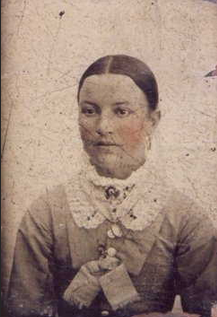
Jemima Oxenham from Ancestry family trees.