Pipitea Point 1865
“My father has murdered my mother and is cutting his own throat”
This was what six year old Martha Walker told neighbours hurrying to the scene.
Events in the Walker household had been troubled for several months. Thomas and Mary Ann Walker moved from the Rangitikei district to Wellington in September 1865. They had a family of six daughters but only the three youngest were living at home. The family lived in the back part of an iron house at Pipitea Point. The front half was occupied by Thomas and Caroline Lowe.
Thomas’ first appearance in the Wellington courts was on 19th September 1865, charged with being drunk in Molesworth Street at 2am and having violently assaulted and beaten his wife. Mary Ann did not appear in court, fearing the consequences of her husband’s release. Inspector Frederick Atchison was unable to give any evidence other than seeing the blows and bite marks on Mary Ann’s body. When Thomas was bought up on remand a few days later, Mary Ann begged the Bench to overlook the offence as ‘her husband was usually very kind.’ The Bench commented on his brutality and cowardice, but listened to her wishes and warned him never to appear again.
Between 23rd and 29th December, Thomas was largely intoxicated. During that period he came home and said “I want to murder myself.” On 1st January, Mary Ann went out for the day to watch the Caledonian Games in Te Aro. She was observed by others as being sober all day. But she returned home about 10pm intoxicated in the company of a man named Joseph Geary. A quarrel took place between husband and wife, and Mary Ann hit Thomas.
The exact events of what followed are not clear. The newspaper theorised that perhaps Mary Ann took her own life. The testimony of seven year old Emma Walker explained what took place:
“My father beat my mother, took a razor out of her workbasket, and cut her throat. He then put the razor down, but in a while took it up again, and cut his own throat.”
The young Walker daughters fled from the house one by one as the scene unfolded. Gathering a group of adults who found each of the girls in the street, they went to the house and found the two bodies lying on their faces side by side, surrounded by blood. Mary Ann was dead and Thomas lay seriously injured.
The morning after the tragic events, while lying in hospital and unable to speak, Thomas made signs to indicate that he wanted some writing materials. Once given to him, he wrote out directions for Inspector Atchison to search his house for a document that he wanted to be given to the magistrate, Charles Ward. The Inspector followed the directions and located the document which had already been addressed to C.D.R. Ward Esq. On it was written “Rangitikei, December 8th, 1865” and the first page was a testimonial signed by ten gentlemen which read:
“Sir, We, the undersigned settlers in the Rangitikei District, desire to bear testimony that Thomas Walker is a hardworking, industrious man. He has been well known in this district for the past ten years, and by his perseverance he was enabled to purchase a small farm; and, having a comfortable home, was in a way of doing well for himself and his family, but the gross misconduct of his wife, Mary Ann Walker, greatly embarrassed him, and finally compelled him to dispose of his place.”
On the inside page was written:
“This is to certify that I am obliged to commit the deed that I have done, and through her gross misconduct to me. I have done, and I hope you will take my children, and never cast up to them the deed that I have done.”
The inquest on Mary Ann’s body was held at 3pm at Barrett’s Hotel, several hours after the Inspector retrieved the document, although it does not appear to have been used as evidence. After hearing the statements from several neighbours and the medical opinion of Dr Morgan Stanislaus Grace, the jury returned a verdict of ‘wilful murder’ against Thomas Walker.
The Wellington Independent speculated whether Thomas premeditated the murder based on the contents of the document hidden in his home, or whether he added the second note between murdering his wife and attempting his own life. But as the newspaper assumed that he would recover, they ceased speculating anticipating a trial.
A reporter from the Wellington Independent visited Thomas in hospital on Friday 6th January and described his condition as ’each respiration was accompanied by a bubbling gurgling sound, as if he were in the last agonies of suffocation.’ Thomas died the following morning. An inquest was held at the hospital on the same afternoon and the jury returned a verdict that Thomas ‘committed suicide on the 1st January when in a state of unsound mind’.
The couple were buried in the Anglican section of Bolton Cemetery. The grave location is not known.
The Wellington Independent added to their final report:
‘we must express a hope that the good Samaritans of this city will take into consideration the destitute condition of the orphan children, and think them objects worthy of their charity.’
References
Resident Magistrates Court. (1865. September 19). Evening Post, 2.
Resident Magistrate’s Court. (1865, September 21). Wellington Independent, 5.
Resident Magistrate’s Court. (1865, September 23). Wellington Independent, 5.
The Evening Post. (1866, January 3). Evening Post, 2.
Inquest on the Body of Mrs Walker. (1866, January 3). Evening Post, 2.
Local And General News. (Wellington, January 9). Wellington Independent, 5.
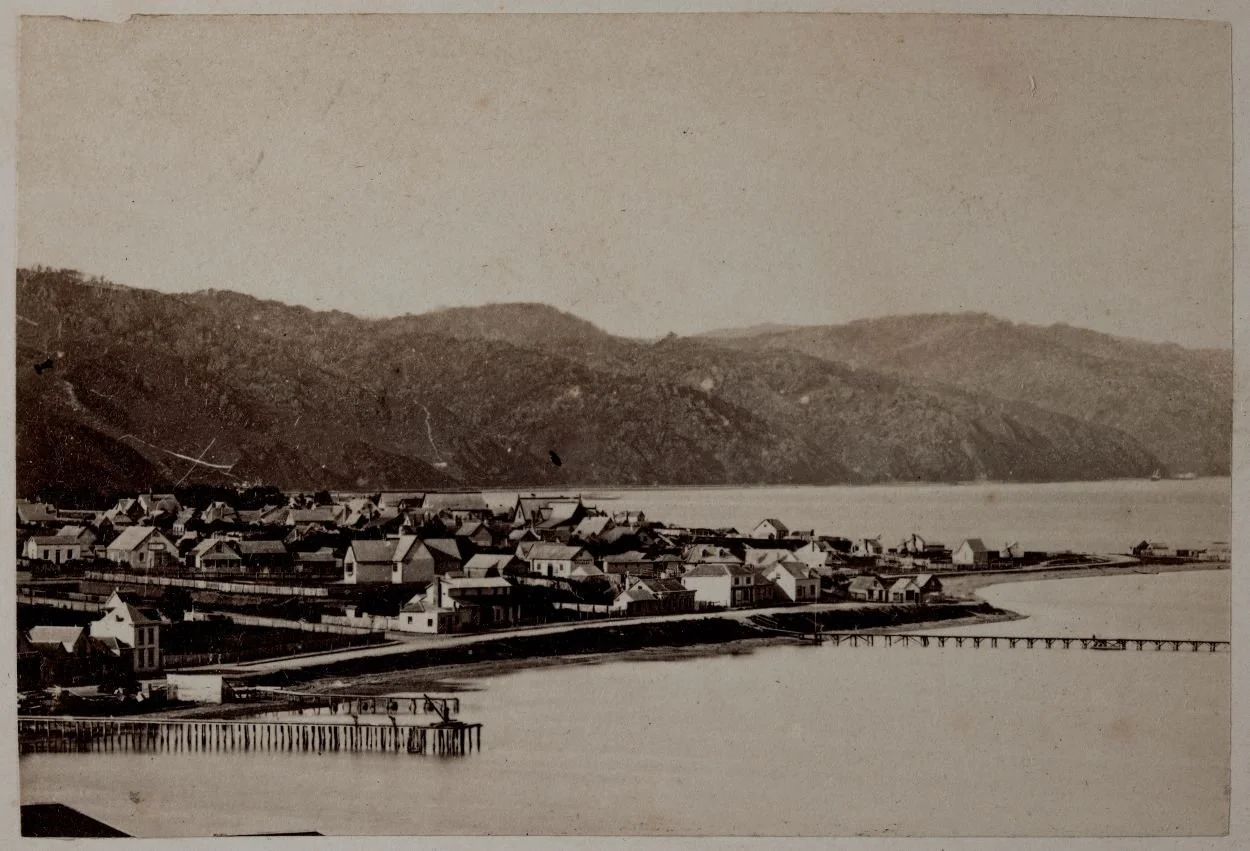
Wellington Pipitea Pt. New Zealand circa 1865. Auckland Museum ref PH-ALB-510-p10-2.