Charles Thompson
A Man Arrested on Suspicion of Murder
On Saturday 27th February 1886, the S.S. Kiwi steamed in to Wellington harbour and seamen Charles Schultz and Charles Thompson took the opportunity to come ashore. The men were described as being like brothers on the ship and would ‘share their last sixpence’ if needed. Thompson was described as ‘a Norwegian’ and Schultz ‘another foreigner.’
The two men had their tea together at 5pm before leaving the steamer. By 1am, they were the worse for liquor and had gone to Matilda ‘Tilly’ Baker’s brothel at Pipitea Point. (William Ebden held the leasehold on several sections of the Pipitea Pa Reserve on which stood several houses let out to tenants who ran brothels)[i]. Schultz began insulting several girls in the house and Thompson wouldn’t stand for it. The name calling between the men descended in to blows and Thompson struck Schultz in the mouth. In response, Schultz said he would murder Thompson.
Schultz continued by insulting Baker, and Thompson said ‘If you insult her or any one in this house you’ll be a dead man before morning.’ Schultz then ran out of the house. Thompson went looking for him but returned half an hour later on his own, looking uneasy and miserable. Baker told him to ‘clear out’ as she wanted to go to bed and he returned to the S.S. Kiwi.
Questioned by another crew member the next morning, Thompson said “Charlie and I had a few words, and he said he’d never speak to me again. He went one way and I went another.” The vessel sailed a few days later, without Schultz. A description of the missing man was placed in the newspapers, but the police could not trace his whereabouts.
‘Height, 5ft 10in, medium build, hair cut close to the head, fresh complexion, moustache, remainder of face close shaven, and about 40 years of age. Any information concerning the man, who is supposed merely to have gone on a drunken spree, will be received by the police.’
On Saturday one week later, John Ruff and Michael O’Donnell saw a body floating in the water near Queen’s Wharf. It was identified as Schultz. The S.S. Kiwi returned to Wellington the next morning. Detective Chrystal boarded the steamer and after questioning Thompson, took him to the lock-up on suspicion of murdering Schultz. Dr Fell conducted the post mortem with some difficulty, due to the body being partially decomposed and eaten by crabs. There were no marks of violence on the body and in Fell’s opinion the death was caused by drowning.
On 8th March, the coroner had great trouble in assembling the jury due to the ‘abominable smell arising from the corpse of Charles Schultz.’ Assemble they did, and the jury returned a verdict of ‘Found Dead in the Harbour.’ Thompson was formally discharged.
Schultz who ‘had no friends in the colony’ was buried in Bolton Street cemetery.
References:
Mysterious Drowning Case. (1886, March 12). New Zealand Mail, 17.
The Missing Man Schultz. (1886, March 6). Evening Post, 3.
Untitled. (1886, March 9). Evening Post, 2.
Untitled. (1886, March 9). New Zealand Times, 2.
[i] Magistrate’s Court. (1884, April 3). Evening Post, 2; Magisterial. (1884, July 9). New Zealand Times, 2; Advertisement ‘In the Exchange Land and Mercantile Auction Rooms.’ (1892, June 1). Evening Post, 3; ‘Land Sale’ (1892, January 29). New Zealand Mail, 23.
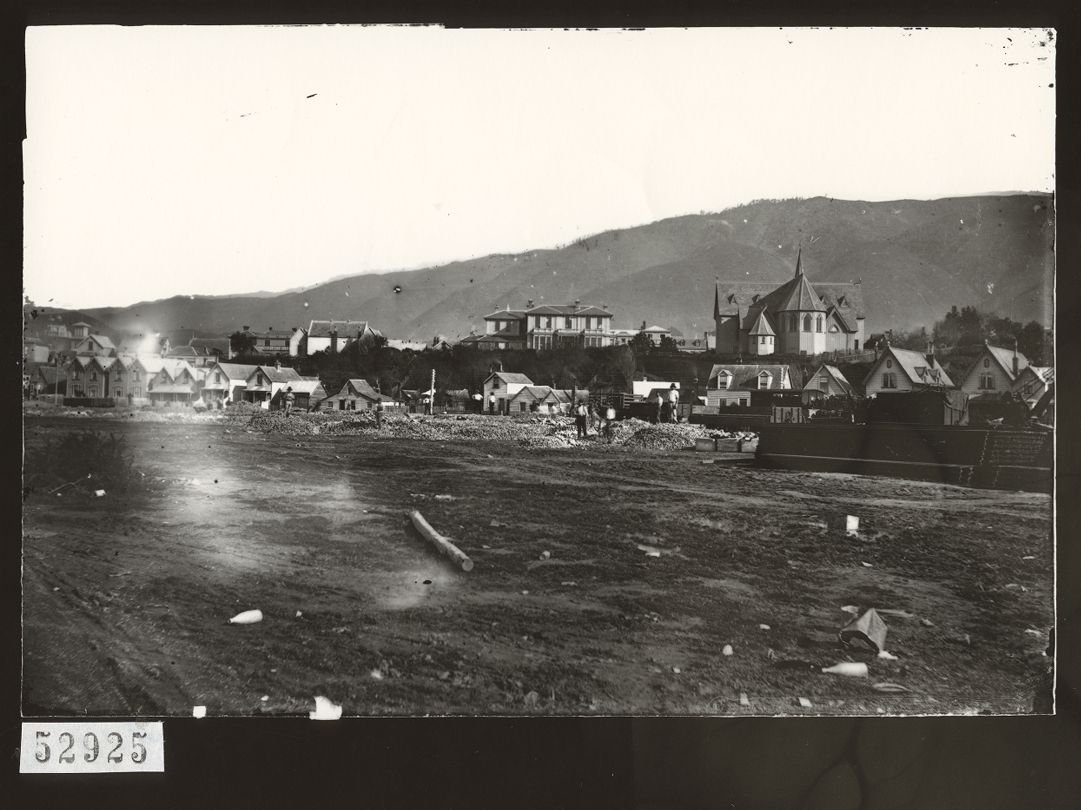
Ebden’s properties are out of view to the right of this frame, ironically almost within view of Bishop’s Court.
Thorndon Quay, Wellington. Davis, William Henry Whitmore, 1812-1901 :Photographs of Wellington and district. Ref: PA7-12-61. Alexander Turnbull Library, Wellington, New Zealand. /records/22321366