Harriot Riddiford
Ōrongorongo Station
As their only daughter, it was no wonder Richard and Mary Stone were alarmed when Harriot’s betrothed started talking about emigrating to New Zealand in 1838. Harriot and Daniel Riddiford had been engaged for 3 years. The Stone’s risked losing Harriot to an unknown country at the other end of the world, and so they withdrew their consent to the marriage.
Daniel’s mother, Harriet Evans, helped the pair ‘elope’ (Harriot was 23 years old and so there was no legal impediment to her marrying). The couple were married on 18th January 1839 at the Holy Trinity Church in Brompton, London. Resigned to the marriage, her parents gave her a generous dowry which included ‘a twelve-piece canteen of silver, articles of linen and furniture, and a large and well-stocked medicine chest.’
In 1839, the New Zealand Company’s plans for their first settlement started to see action. The ship Tory departed for New Zealand in May to survey and conduct land acquisitions. The first emigrant ships departed later in the year. The Company appointed Daniel Riddiford as emigration agent for their first settlement. The Riddiford’s joined the ship Adelaide. Harriot was now expecting her first child and so her parents employed a nurse to accompany her on the long voyage.
The Adelaide was not a harmonious ship and various factions formed with dislike focussed on Dr Samuel Evans, Daniel’s stepfather, who had been appointed judge for the settlement. Yet amongst the friction, Harriot gave birth to a daughter named Ellen on 29th November. The ship arrived at Port Nicholson in March 1840. Here Daniel immediately took up his agent duties.
In 1845, the Riddiford’s moved to land he leased at Ōrongorongo. Daniel built a pit-sawn totara hut for the family and cleared land for grazing sheep. The location was so isolated that Harriot was only visited by one European woman during her time there.
For the births of her children, Harriot went to Wellington. She was rowed there in a canoe, navigating the waters of Cook Strait and Baring Head. In total, she was the mother of twelve children who all lived to adulthood. Her family grew up alongside children from the neighbouring pā and they learnt to speak fluently in Te Reo.
Daniel was away from Ōrongorongo when the 1855 Wairarapa earthquake struck. The event destroyed their homestead and raised the coastline by about 5 feet. Harriot managed the evacuation of her children from the station. They put as many of their possessions as would fit into a Māori canoe and made the journey by sea to a new home ‘Woburn’ in the Hutt Valley.
Daniel died in 1875 and left Harriot all of the land he controlled at Te Awaiti, Ōrongorongo and Woburn, as well as a half share in profits of Ōrongorongo station run by their son. Harriot moved to Wellington and lived in a house on Tinakori Road named ‘Lindfield’ after the Sussex parish she was born in. She died on 6th September 1891 and was buried in in St James’ churchyard in Lower Hutt where Daniel is also interred.
References:
Holy Trinity Brompton marriages (Ancestry)
Riddiford, H. (2014). A Blighted Fame George S. Evans 1802-1868, A Life.
Victoria University Press.
https://wainuiomata.net/history/riddiford-family-of-wainuiomata/ by David Johnson
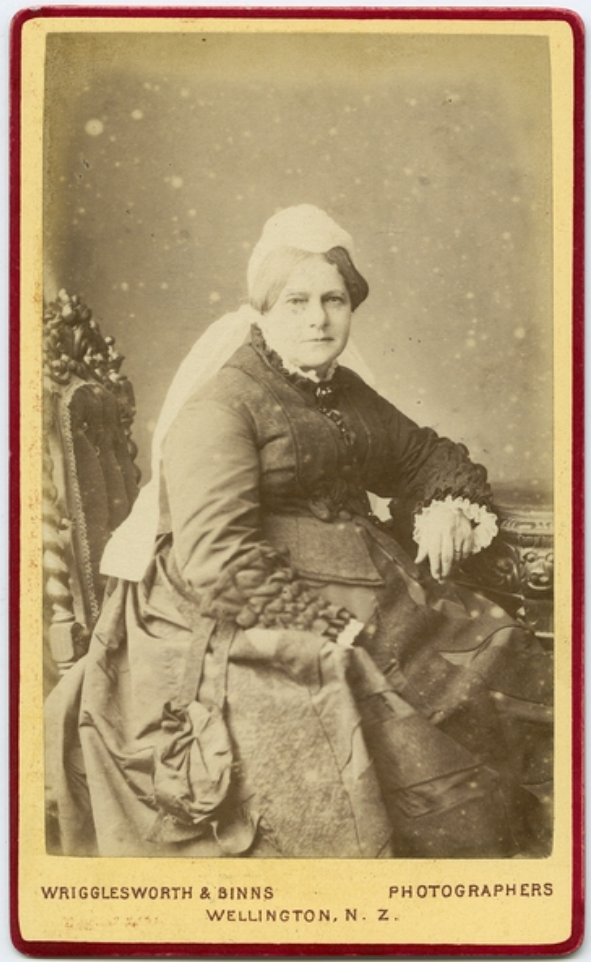
Studio photograph of a woman identified only as Mrs Riddiford. Possibly Harriot Riddiford, nee Stone (1816-1891). Masterton District Library record number 3754623